The Budget That Arrives After You Sign: What Hotel Owners Are Never Told About Brand Costs
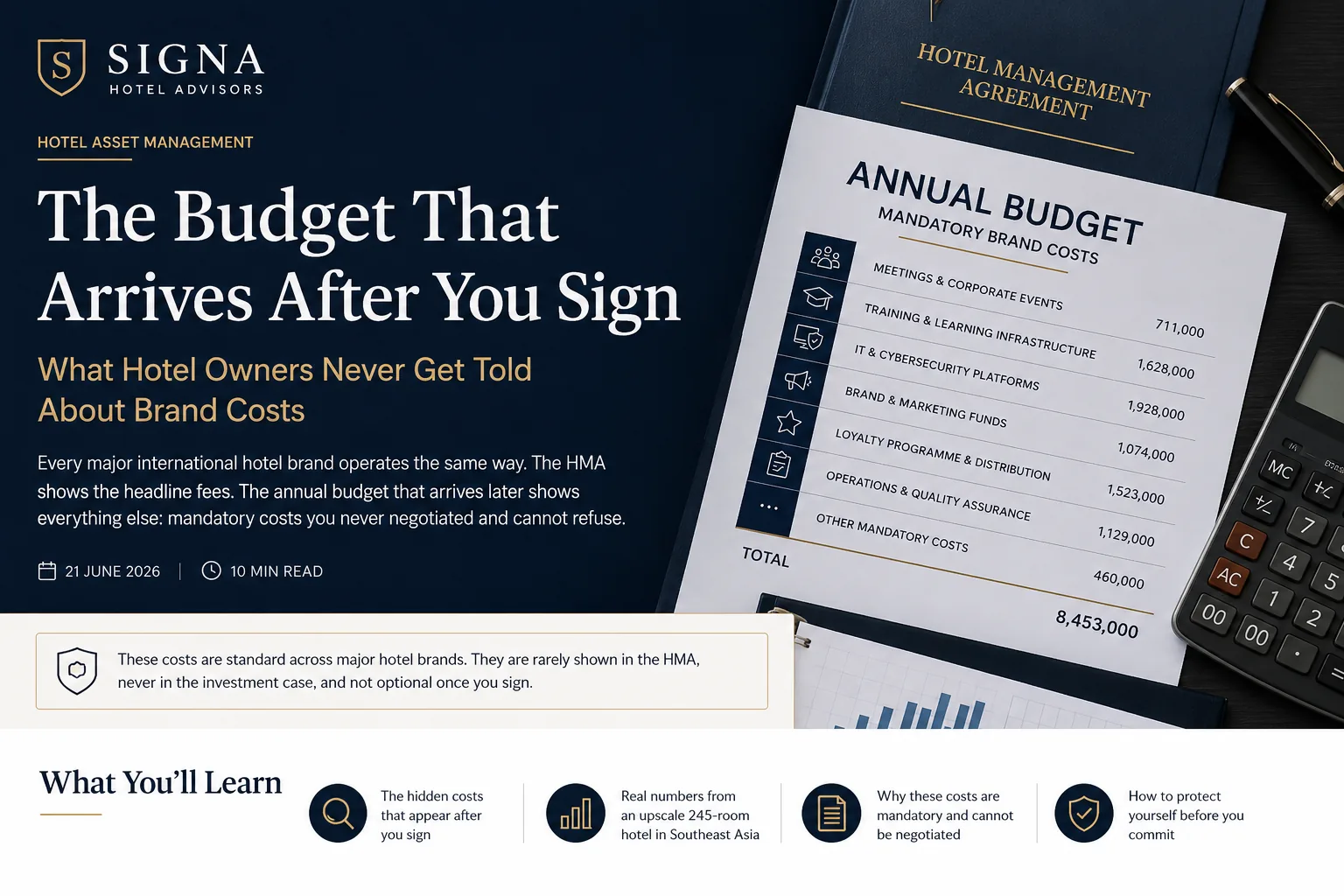
Every major international hotel brand tells owners the same story at the HMA negotiation table. The headline is simple: base management fee, incentive management fee, and a broad reference to centralised service programmes. The owner's lawyers scrutinise the percentages. Both sides negotiate hard on the numbers that are visible.
What neither side discusses in detail, and what no brand will walk you through at signing, is the annual budget that arrives in October or November of your first operating year. That budget contains a long list of mandatory charges that were never itemised in the HMA, never modelled in the investment case, and cannot be refused without breaching brand standards.
This is not a failing of one operator. It is how every major international hotel management group operates. The mechanism is the same across brands: broad contractual language gives the operator the right to mandate participation in group programmes and charge the cost back to the property. The specific amount is only known when the budget is set.
By then, you have already signed.
The Two Conversations
There are two conversations in every HMA process. The first happens at the negotiating table. It covers base management fee, incentive management fee, key money, performance termination rights, and approval mechanisms. This is where owners and their advisors focus their energy.
The second conversation happens during your first budget cycle. This is where the real cost of brand affiliation becomes visible, line by line, for the first time.
To illustrate the scale of what that second conversation looks like, consider a 245-key upscale managed hotel in Southeast Asia. The figures below are drawn from a real annual budget exercise at a property of this type, adjusted to prevent identification of the specific hotel. Every line marked mandatory below is non-negotiable under the brand's operating standards.
Category 1: Conferences and Corporate Events
Every major hotel brand holds an annual calendar of corporate events in their regional headquarters city. General managers, directors of finance, directors of sales and marketing, revenue managers, and HR leaders are all expected to attend their respective conferences. The hotel pays.
At a 245-key upscale property, the mandatory conference cost stack for a single year looks like this:
| Event | THB |
|---|---|
| General Manager Conference | 118,000 |
| Director of Finance Conference | 96,000 |
| Director of Sales Conference | 162,000 |
| HR and Learning Conference | 68,000 |
| L&D Excom Workshop | 82,000 |
| New GM and EXCOM Orientation | 71,000 |
| Global Commercial and Marketing Conference | 114,000 |
| Total | 711,000 |
Over THB 711,000 per year in flights, accommodation, and conference costs for your team to attend events organised by and for the benefit of the brand. None of this appears as a line item in the HMA.
Category 2: Mandatory Training and Learning Infrastructure
The brand mandates a learning application, specific training programmes, and associated materials. The hotel provides the employees. The hotel also pays the licences, content fees, and delivery costs.
| Item | THB |
|---|---|
| Brand learning application licence (per employee, per month) | 445,000 |
| Brand Service Standards Training (new) | 820,000 |
| Compliance Training | 145,000 |
| Leadership Development Programme (new) | 98,000 |
| L&D Accreditation (new) | 71,000 |
| External management enrolments | 31,000 |
| Orientation collateral, materials, videos | 18,000 |
| Total | 1,628,000 |
The brand learning application licence cost at this property increased by 233% year-on-year following a brand decision to change the per-employee pricing formula. The asset manager flagged this only after the budget was submitted. The owner was not consulted on the change.
The Brand Service Standards Training charge of THB 820,000 appeared for the first time in the budget with no equivalent in the prior year.
Category 3: IT and Cybersecurity Platform Stack
The brand mandates a specific suite of technology platforms across every property in the portfolio. These include cloud infrastructure, cybersecurity tools, endpoint protection, service desk systems, and data management platforms. The hotel pays per-device, per-user, or fixed-property fees for each.
| Platform | THB |
|---|---|
| Microsoft 365 subscription | 149,000 |
| Endpoint protection and vulnerability assessment | 196,000 |
| Firewall Managed Services | 485,000 |
| Email cloud security | 22,000 |
| Private cloud hosting and operations (new) | 545,000 |
| Global IT Service Desk (new) | 73,000 |
| Server Extended Support (new) | 155,000 |
| Workflow application | 61,000 |
| IT Asset Management System (new) | 23,000 |
| Administrative Access Management (new) | 99,000 |
| Data Loss Protection (new) | 58,000 |
| Mobile Device Management (new) | 43,000 |
| Cloud backup storage | 19,000 |
| Total | 1,928,000 |
Seven of these thirteen line items appeared for the first time in the budget. The prior year equivalent total for this category was approximately THB 1,250,000. The increase of roughly THB 678,000 was not flagged in advance, negotiated, or subject to owner approval. It appeared in the draft budget as mandatory.
Category 4: Revenue and Distribution Systems
The brand operates a suite of mandatory revenue management and distribution platforms. Every property in the portfolio is enrolled by default. The hotel pays per-room, per-booking, or subscription fees for each system.
| Platform | THB |
|---|---|
| Channel Manager subscription | 128,000 |
| Metasearch integration | 32,000 |
| Regional outbound market distribution system | 54,000 |
| GDS connectivity and processing fees | 41,000 |
| Business Intelligence subscription | 110,000 |
| Rate parity monitoring (new) | 42,000 |
| Rate shopping tool (new) | 56,000 |
| Market benchmarking suite (new) | 86,000 |
| Corporate RFP platform (new) | 63,000 |
| Sales and Catering system subscription (new) | 265,000 |
| Total | 877,000 |
Five of these ten items were not in the prior year budget. The Sales and Catering system subscription of THB 265,000 was a brand-mandated new system rollout. The hotel had no input into the platform selection, the vendor negotiation, or the price.
Category 5: Sales, Marketing, and Brand Compliance
This is the largest and most varied category. It covers the cost of maintaining the brand's marketing infrastructure at property level, participating in brand-mandated promotional activities, and complying with brand standards for guest communication and content production.
| Item | THB |
|---|---|
| Pay-per-click advertising campaigns | 548,000 |
| Metasearch advertising campaigns | 112,000 |
| Remarketing display campaigns | 118,000 |
| Brand website hosting and maintenance | 535,000 |
| Chatbot licence and maintenance | 133,000 |
| Loyalty programme connections maintenance | 94,000 |
| Loyalty app maintenance | 22,000 |
| Email marketing campaigns | 148,000 |
| Brand Signature Activation (mandatory rollout) | 186,000 |
| Hotel brand video production (mandatory) | 965,000 |
| Brand collateral production | 158,000 |
| Brand Day event | 131,000 |
| Guest satisfaction survey platform | 54,000 |
| International trade show participation | 285,000 |
| Loyalty member acquisition programme | 318,000 |
| Travel agent and booker engagement programme | 195,000 |
| Regional outbound social media campaign (new, mandatory) | 86,000 |
| Global distribution partnership fees (mandatory) | 88,000 |
| Review and listing platform subscription | 75,000 |
| Mystery shopper audits | 72,000 |
| Brand promotional giveaway items (mandatory) | 48,000 |
| Total | 4,371,000 |
The hotel brand video production charge of THB 965,000 is a mandatory one-off brand compliance cost. The brand sets the brief. The brand sets the standard. The owner pays for the production.
The regional outbound social media campaign, mandatory for all properties in the relevant markets, appeared as a new line at THB 86,000 with no prior year equivalent.
The Total Picture
Across the five categories, the mandatory and quasi-mandatory brand charges in a single budget year at this 245-key property total approximately:
| Category | THB |
|---|---|
| Conferences and corporate events | 711,000 |
| Training and learning infrastructure | 1,628,000 |
| IT and cybersecurity platforms | 1,928,000 |
| Revenue and distribution systems | 877,000 |
| Sales, marketing, and brand compliance | 4,371,000 |
| Total | 9,515,000 |
That is approximately THB 9.5 million per year in charges that do not appear in the HMA, are not negotiated at signing, and arrive for the first time in the annual budget. At a typical 245-key upscale property in Southeast Asia with average daily rate of approximately USD 150 and 70% occupancy, this figure represents roughly 8-10% of total room revenue on top of the headline management fees already disclosed.
In the year reviewed above, approximately 40% of the line items in this budget were new charges with no prior year equivalent. The asset manager identified them during budget review in October.
The Direct Booking Connection
Here is where the "book direct" narrative becomes particularly pointed.
The brand pushes its "book direct" strategy hard. The rationale is compelling: reduce OTA dependency, lower commission costs, build loyalty membership, create a stronger direct relationship with the guest.
What the brand does not explain is that the entire infrastructure that makes "book direct" possible at the property level is funded by the owner.
The brand website hosting and maintenance: owner pays. The pay-per-click campaigns that drive traffic to the brand site: owner pays. The metasearch advertising: owner pays. The chatbot that converts browsers to bookers: owner pays. The loyalty app maintenance: owner pays. The email marketing programme: owner pays. The loyalty member acquisition programme: owner pays. The remarketing campaigns: owner pays. The regional outbound social media campaigns that feed the direct channel: owner pays.
The brand builds its loyalty database, its first-party data pool, and its system-wide booking share. The individual hotel owner funds the machinery that makes it possible, then receives a marginally lower acquisition cost per booking in return.
That marginal saving is real. But it needs to be measured against the full cost stack described above, not against OTA commission alone.
For a full breakdown of how to model the actual channel economics, read our companion revenue management analysis from ARCC Group: The True Cost of a Direct Hotel Booking.
What Should Have Been Negotiated
None of what is described above is hidden in the literal sense. It is referenced in HMA schedules, service agreements, and brand standards documents. But it is chronically under-specified at signing and chronically under-modelled in investment cases.
A strong asset manager or owner representative, engaged before HMA signing, would have:
Demanded a complete, itemised schedule of every anticipated annual brand charge by category, with the formula, the charging basis, the right to audit, and a cap on year-on-year escalation.
Required the operator to model a 10-year all-in owner cost projection including every mandatory programme, not just base and incentive fees.
Negotiated annual budget approval rights with real teeth, including a defined process for challenging new mandatory programme introductions and a cost threshold above which the owner's approval is required before a new charge is added.
Pushed for a cap or notification requirement on per-unit cost increases above an agreed percentage, protecting against the kind of 233% application licence increase described above.
Required property-level reporting on the ROI of each major spend category, particularly loyalty programme fees and direct marketing expenditure, to verify that the cost is generating proportionate benefit for the specific hotel, not just for the brand network.
For a wider review of the operating plan before approval, use our annual hotel budget owner's checklist.
The Honest Assessment
International hotel brands are not acting in bad faith. These charges fund real services and real infrastructure. Some of it genuinely benefits the property. The technology stack, the distribution systems, and the marketing platforms have value.
But the value to the individual hotel owner is not the same as the value to the brand. The brand builds a global platform. The owner pays a property-level share of that platform. The return on that investment at property level is rarely measured, rarely reported, and almost never audited.
The owner who signed the HMA based on headline fees alone and discovered THB 9.5 million in additional annual charges in their first October budget is not uniquely unlucky. They are typical.
The owner who had an experienced asset manager at the table before signing is the exception. They are also the owner who understood what they were agreeing to.
Signa Hotel Advisors provides independent hotel asset management and owner representation services across Thailand and Southeast Asia. For a confidential review of your HMA fee structure or annual budget, contact us at signahoteladvisors.com.
Related reading: Book Direct, But Who Captures the Value? and The True Cost of a Direct Hotel Booking (ARCC Group)
Continue reading
- Reviewing Your Annual Hotel Budget: An Owner's Checklist
- 10 Numbers Every Hotel Owner Should Check in the Monthly Report
- Capture, Not Dwell: What the RevPAG Argument Misses in Thailand
- Hotel Loyalty Programmes: What Owners Need to Test Before Signing
- Book Direct, But Who Captures the Value?
- Hotel Operator Selection in Thailand: An Owner's Guide
- Hotel Feasibility Study in Thailand: An Investor's Guide
- Hotel Asset Management in Thailand: An Owner's Guide
- Signa hotel asset management & HMA review services
- The True Cost of a Direct Hotel Booking
Need a confidential review of your hotel?
Signa Hotel Advisors represents hotel owners across Thailand and Southeast Asia on asset management, feasibility, operator selection and HMA negotiation.
Speak with our team