Hotel Loyalty Programmes: What Owners Need to Test Before Signing
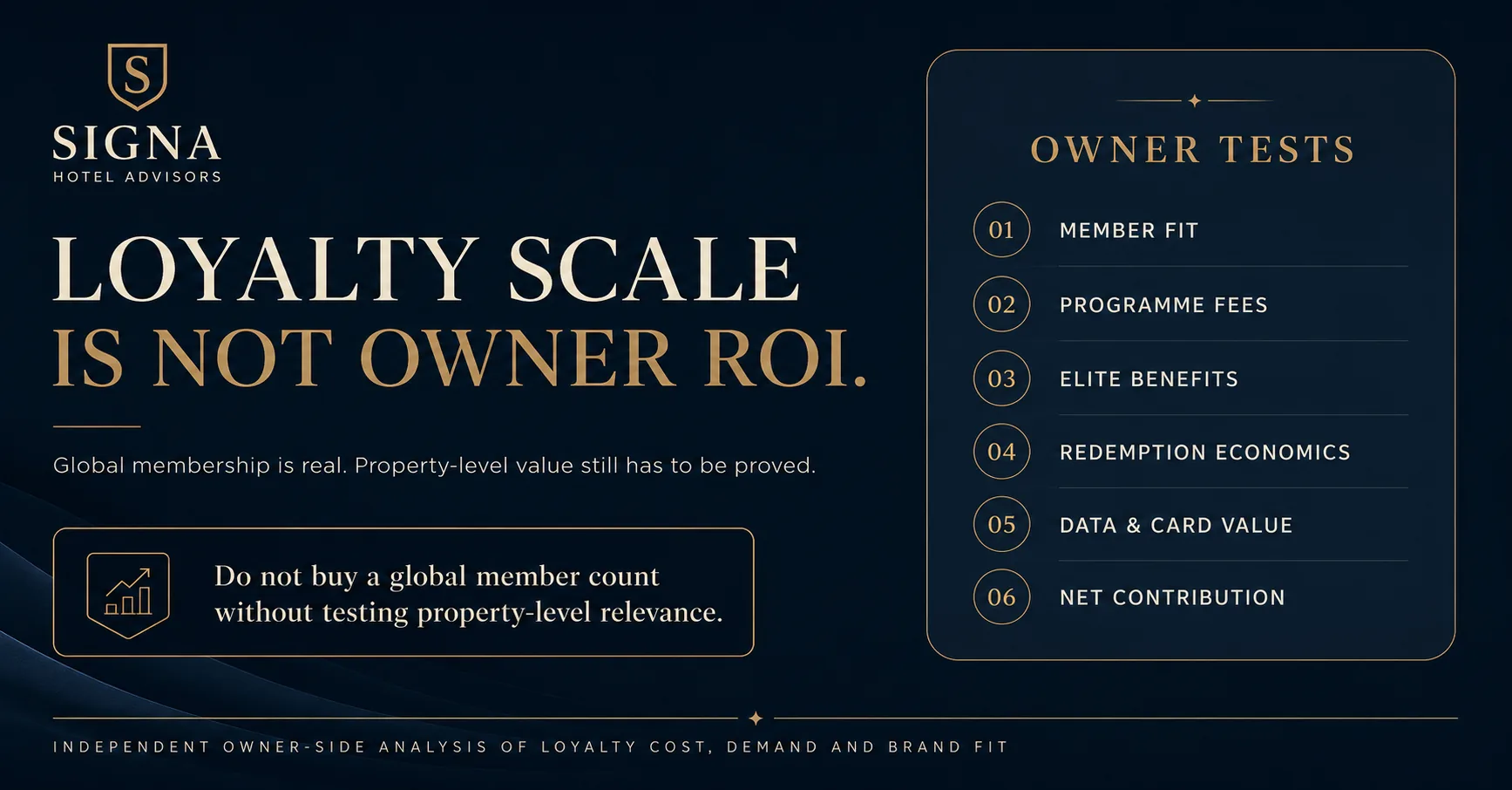
Answer in brief: Global loyalty scale can be valuable, but membership count is not a property-level return forecast. Before signing an HMA or franchise agreement, the owner should test whether the programme attracts guests relevant to the hotel's market and price point, what the hotel will pay, which benefits it must deliver, how reward stays are reimbursed, what data and control the owner receives, and whether the resulting net contribution exceeds alternative distribution options.
Key takeaways
- Marriott Bonvoy had nearly 283 million members at the end of Q1 2026.
- Hilton reported 251 million Hilton Honors members at 31 March 2026.
- IHG One Rewards reports more than 160 million members.
- These are verified global figures. They do not show how many active members fit a specific Thai hotel.
- CBRE found that loyalty members accounted for 52.8% of occupied rooms across the public-company data it analysed in 2024.
- CBRE also found that loyalty fees averaged USD 5.46 per occupied room, or 1.6% of total revenue, across its relevant U.S. hotel dataset.
- The same CBRE research concludes that loyalty programmes remain relatively cost-efficient demand drivers overall.
- The owner still needs a property-level model because costs, member mix, benefit obligations and source-market relevance vary.
- Programme economics should be compared with OTAs and other demand sources using net contribution, not gross room nights.
The scale is real
Major hotel loyalty platforms have reached extraordinary scale.
Marriott reported nearly 283 million Bonvoy members at the end of the first quarter of 2026. Hilton's May 2026 investor presentation reported 251 million Hilton Honors members as of 31 March. IHG states that IHG One Rewards has more than 160 million members. Accor announced that ALL reached 100 million members in March 2025.
CBRE analysed public information from five major hotel companies and found that total membership increased by 14.5% in 2024 to more than 675 million, while members per available room increased by 7.4%.
This scale can produce:
- brand awareness;
- lower-cost direct demand;
- repeat stays;
- shoulder-period occupancy;
- cross-property demand;
- customer data;
- partnership revenue; and
- a broader ecosystem around the hotel stay.
The owner should not dismiss those benefits.
The owner should also not confuse the size of the ecosystem with the value delivered to one hotel.
What the global member count does not show
A global total does not disclose:
- active versus inactive members;
- members duplicated across several programmes;
- members earning mainly through credit cards or partners;
- source-market distribution;
- normal rate level;
- preferred hotel type;
- travel frequency;
- elite-tier mix;
- destination interest; or
- actual production at comparable hotels.
CBRE's research makes this distinction clear. Loyalty room nights increased, but average room nights per member declined from 1.1 in 2023 to 1.0 in 2024. CBRE says the expanding base includes more inactive, overlapping, infrequent and partner-driven members.
That does not make the membership number false.
It means the owner needs the denominator behind the headline.
The Thailand relevance test
Thailand received 32.97 million international visitors in 2025. Its five largest source markets were Malaysia, China, India, Russia and South Korea.
The United Kingdom and United States each exceeded one million arrivals, demonstrating that long-haul Western demand remains important. The market mix, however, differs materially by destination, hotel type and price point.
A Bangkok upper-upscale hotel with multinational corporate demand may benefit strongly from a global business-travel loyalty programme.
A Phuket or Samui resort may depend more heavily on regional leisure markets, tour operators, wholesalers, OTAs and European long-haul demand.
A Chiang Mai boutique hotel may have a different source mix again.
The brand should therefore provide evidence from comparable properties, not only global or regional programme statistics.
Request:
- member room nights by source market;
- member penetration;
- member ADR;
- tier mix;
- stay frequency;
- reward-night mix;
- channel of booking; and
- comparable hotel performance.
The cost is broader than the loyalty fee
The contractual programme charge is only one part of the owner economics.
Property-level costs can include:
- loyalty or participation fees;
- reservation and system charges;
- member-rate discounts;
- points-related charges;
- food and beverage credits or breakfast;
- lounge access;
- welcome amenities;
- upgrades;
- late checkout;
- housekeeping and operational disruption;
- compensation points;
- training;
- technology; and
- programme compliance.
The exact treatment varies by brand, property, market and contract.
Industry practitioners commonly cite loyalty assessment or participation charges in the region of 1% to 3% of qualifying room revenue for some major programmes. This is a reasonable indicative range, not a universal tariff. The actual formula may use qualifying revenue, eligible stays, points issuance, fixed charges or several separate programme assessments.
It is not accurate to state that every benefit is entirely funded by the hotel or that every programme uses the same fee formula. Some benefits are reimbursed, centrally funded, restricted by property type or delivered differently by region.
The owner should use:
- the actual HMA or franchise agreement;
- programme schedules;
- current standards;
- comparable hotel invoices; and
- the proposed annual budget.
What current cost data says
CBRE's 2024 analysis found:
- loyalty fees increased by 4.4%, faster than 2.7% total revenue growth;
- cost averaged USD 5.46 per occupied room;
- loyalty fees represented 1.6% of total revenue; and
- loyalty programmes remained a relatively cost-efficient way to support occupancy overall.
A later CBRE analysis of 4,187 U.S. hotels reported loyalty fees averaging 2.2% of rooms revenue in 2024, with the highest ratio at upper-upscale hotels.
These figures use different denominators and samples. They should not be mixed as though they are the same metric.
They are also U.S. benchmarks.
They are useful for context, not a substitute for a Thailand property model.
Elite status changes can alter property cost
Hilton introduced revised status requirements in January 2026.
Gold now requires 25 nights, 15 stays or USD 6,000 of eligible spend. Diamond requires 50 nights, 25 stays or USD 11,500 of eligible spend. Hilton also introduced Diamond Reserve.
A lower nights threshold can increase the number of members qualifying through nights, while the new spend route and removal of rollover rules change the wider effect.
The owner should not assume the outcome automatically.
The practical response is to track:
- elite room nights by tier;
- property benefit cost;
- ADR and ancillary spend;
- repeat frequency;
- upgrade displacement;
- satisfaction; and
- net contribution.
Programme changes should trigger a revised cost and demand forecast.
Redemptions require actual programme data
A reward stay is not automatically unprofitable, but reimbursement frequently runs below the commercial ADR available to the hotel.
Many programmes use occupancy-sensitive or otherwise tiered reimbursement formulas. Compensation may increase when the hotel reaches defined high-occupancy thresholds. Even then, reimbursement can remain below the rate the hotel could have sold, and the opportunity-cost gap can be most material on compressed dates.
The June 2026 Marriott owner dispute supports this concern. Owners asked for reforms to the reimbursement structure and compensation closer to the economics of third-party bookings. Marriott stated that it had recently increased owner compensation for loyalty stays on high-demand nights.
Reward guests may also generate food, beverage, spa and other spend. A reward stay can create value in a shoulder period and displace higher-rated commercial demand on a compressed date.
The owner needs date-level analysis covering:
- reward room nights;
- reimbursement;
- occupied-room cost;
- ancillary contribution;
- comparable paid ADR;
- sell-out or compression status; and
- alternative demand displaced.
Availability control is programme- and contract-specific. Some programmes and agreements provide limited tools around standard-room inventory, blackout dates or exceptional dates. Others provide little or no property discretion. Hilton's published rules state that reward stays are not subject to blackout dates or capacity controls, while Marriott describes a limited-blackout policy. The owner should obtain the exact rules before assuming the hotel can restrict reward inventory or influence the points requirement.
The credit-card economics question
Loyalty programmes are increasingly connected to co-branded credit cards and other partnerships.
Marriott stated that Bonvoy added approximately 43 million members during 2025, reaching nearly 271 million by year-end and nearly 283 million by the end of Q1 2026.
In June 2026, The Wall Street Journal reported that 51 owners representing nearly 1,000 Marriott hotels had asked Marriott for a larger share of the economics linked to Bonvoy and co-branded cards. The report stated that Marriott expected co-branded card fee revenue to increase by 35% in 2026 to nearly USD 1 billion.
This is a current owner-brand dispute, not proof that every loyalty programme is unfair.
Owners generally do not participate directly in the economics of co-branded card agreements, although programme revenue can support the wider loyalty ecosystem and the demand it delivers to hotels. The issue is whether the property-level obligations and reimbursement remain proportionate to the value received.
It does demonstrate why owners need transparency around:
- programme revenue;
- property obligations;
- reimbursement;
- fee changes;
- card-related acquisition;
- benefit funding; and
- the allocation of value between brand and owner.
Six tests before signing
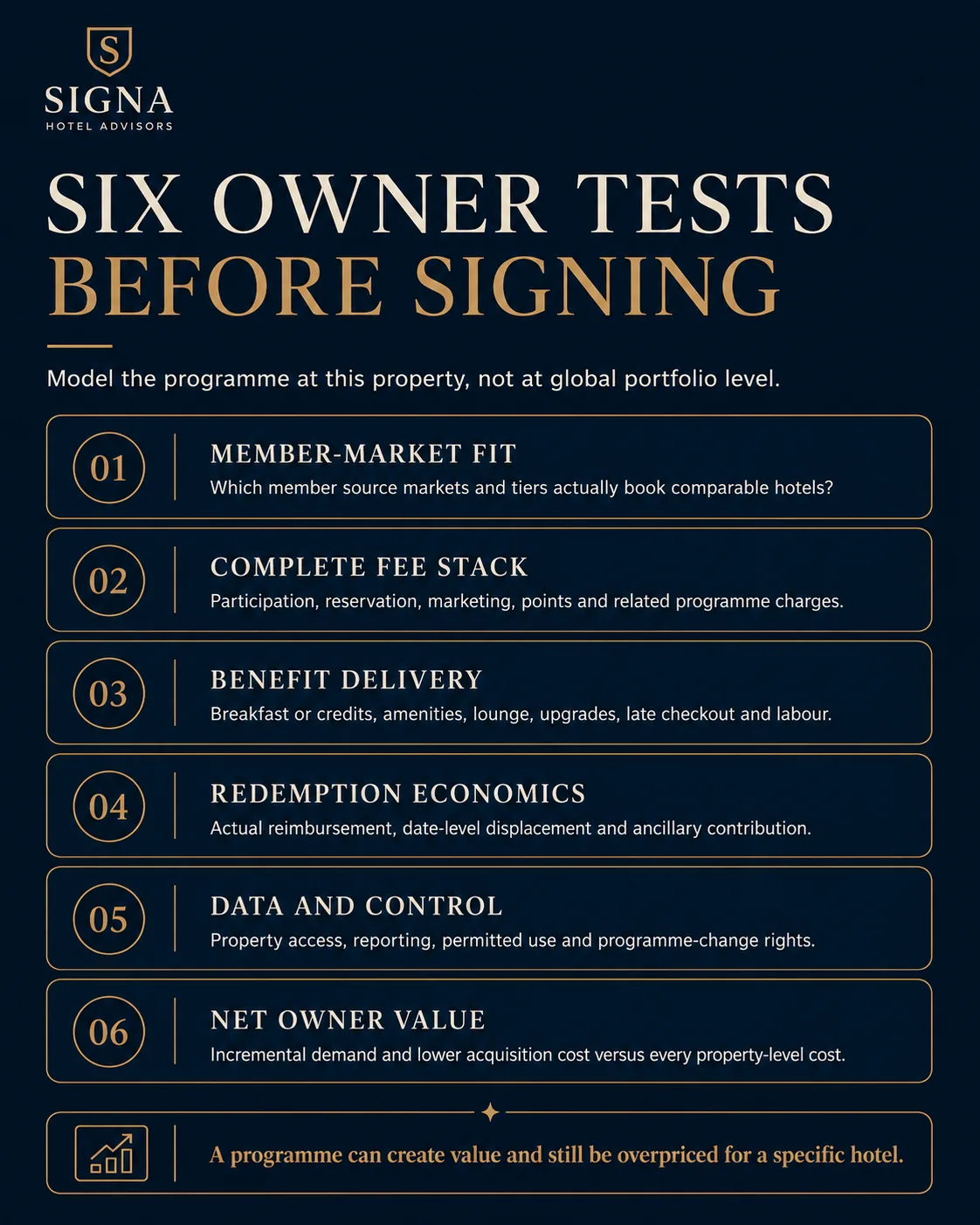
1. Member-market fit
Ask for comparable-property evidence by source market, rate level, hotel type and tier.
2. Complete fee stack
Model every mandatory charge, formula, indexation right, system fee and programme change mechanism.
3. Benefit delivery
Estimate the hotel's actual cost using the property's service model, not generic online ranges.
4. Redemption economics
Review reimbursement and displacement using date-level scenarios.
5. Data and control
Define owner access to member production, source market, tier, channel, benefit cost and reward-stay data.
6. Net owner value
Compare loyalty contribution with OTA, wholesale, corporate, group and independent direct alternatives.
What should be negotiated
The owner should seek:
- complete programme schedules;
- fee formulas;
- comparable hotel examples;
- notice of material changes;
- budget visibility;
- audit rights;
- property-level reporting;
- data access;
- transition rights;
- treatment after termination or sale; and
- clear responsibility for benefit costs and reimbursement.
A hard owner approval right over every programme change may not be achievable.
The contract should still create visibility, consultation and a commercial escalation path.
The balanced conclusion
CBRE's research supports the argument that loyalty programmes create significant demand and remain relatively cost-efficient at industry level.
That is not the same as saying every programme is correctly priced for every hotel.
A strong programme can deliver:
- direct demand;
- repeat stays;
- lower OTA dependency;
- shoulder-period occupancy;
- higher-value members;
- wider distribution; and
- brand preference.
The owner must determine whether those benefits reach the specific hotel in sufficient quantity and at sufficient margin.
The correct position is not anti-brand or anti-loyalty.
It is:
Show the property-level demand, disclose the complete cost and prove the net contribution.
Related revenue-management analysis
Read ARCC Group's companion article: Hotel Loyalty Programme Economics: What Revenue Managers Must Measure
Sources and methodology
Facts were reviewed on 23 June 2026.
- Marriott Q1 2026 results
- Marriott Q4 and full-year 2025 results
- Hilton May 2026 investor presentation
- Hilton Honors 2026 tier changes
- IHG One Rewards owner value
- Accor ALL reaches 100 million members
- CBRE: Key findings from more than 675 million members
- CBRE: Benefits and costs continue to rise
- Thailand 2025 tourism performance
- The Wall Street Journal: Marriott owner loyalty dispute
- Hilton Honors programme terms: reward availability
- Marriott Bonvoy: limited blackout dates
Signa Hotel Advisors provides independent hotel asset management, HMA review and owner representation across Thailand and Southeast Asia.
Continue reading
- Reviewing Your Annual Hotel Budget: An Owner's Checklist
- 10 Numbers Every Hotel Owner Should Check in the Monthly Report
- Capture, Not Dwell: What the RevPAG Argument Misses in Thailand
- The Budget That Arrives After You Sign: What Hotel Owners Are Never Told About Brand Costs
- Book Direct, But Who Captures the Value?
- Hotel Operator Selection in Thailand: An Owner's Guide
- Hotel Feasibility Study in Thailand: An Investor's Guide
- Hotel Asset Management in Thailand: An Owner's Guide
- Signa hotel asset management & HMA review services
- Hotel Loyalty Programme Economics: What Revenue Managers Must Measure
Need a confidential review of your hotel?
Signa Hotel Advisors represents hotel owners across Thailand and Southeast Asia on asset management, feasibility, operator selection and HMA negotiation.
Speak with our team